
 English
 中文简体
 русский




Article Directory
- 1 What an Automotive Wire Compound Is Actually Judged Against
- 2 Heat Resistance: The Dwell Time Is the Number That Counts
- 3 Oil Resistance: Fluid, Temperature and Dwell Time Travel Together
- 4 Flexibility: A Finished-Wire Property, Not a Resin Property
- 5 Comparing PVC, Cross-Linked Polyolefin and Silicone
- 6 How to Evaluate a Supplier in Six Steps
- 7 Decisions That Fix the Specification
A 105 °C PVC automotive wire compound can pass a 240-hour oven test and still crack inside a transmission tunnel after 3,000 hours at the same nominal temperature. The difference between those outcomes is not the number printed on the datasheet, it is the test condition attached to it. Heat resistance, oil resistance and flexibility are each claims about a specific time, a specific fluid and a specific geometry, and they only become comparable when you evaluate them on those terms.
What follows is the evaluation framework we apply when a harness maker or cable extruder sends a compound for qualification: which standards fix the test conditions, which numbers are worth trusting, and which questions expose a material that was never tested for the duty cycle it is sold into.
What an Automotive Wire Compound Is Actually Judged Against
An automotive wire compound is evaluated against the cable standard it must satisfy, not against a generic polymer datasheet, and that standard fixes conductor size, wall thickness, temperature class and fluid exposure before any material property is discussed.
Definition: an automotive wire compound is a formulated polymer, typically plasticised PVC, cross-linked polyolefin or silicone, extruded as insulation or sheath over copper and qualified to a cable specification that fixes its temperature class, wall thickness and resistance to named fluids.
The governing family is ISO 19642, which replaced ISO 6722 and ISO 14572 in 2019 and splits requirements by cable construction: single-core, twisted pair, shielded and sheathed. On the European OEM side, LV 112 and LV 216-2 add manufacturer test matrices; in North America, SAE J1128 and UL 758 cover the vehicle and appliance-wiring sides. Type designations such as FLRY follow DIN 72551.
The temperature class anchors every later test. ISO 19642 and its predecessor define four:
- Class A: -40 °C to +85 °C
- Class B: -40 °C to +100 °C
- Class C: -40 °C to +125 °C
- Class D: -40 °C to +150 °C
That class fixes the ageing temperature, the cold bend temperature and the minimum performance required after both. A compound sold as high temperature without a class has no comparable meaning.
Heat Resistance: The Dwell Time Is the Number That Counts
Heat resistance is a time-at-temperature claim, so a compound rated 125 °C is expected to hold its mechanical properties after 3,000 hours at 125 °C, while a material qualified for a 240-hour exposure at the same temperature is a different product at a different price.
Two mechanisms drive failure inside the polymer. In plasticised PVC, plasticiser migrates and volatilises, so the insulation hardens, shrinks and loses elongation. In cross-linked polyolefin, the antioxidant package is consumed and the cross-link network is attacked by oxidation. Both end in the same field failure: a wire that still passes voltage withstand but cracks when the harness is bent during service.
The test sequence therefore matters as much as the temperature. Ageing alone proves nothing; the specimen is then bent around a mandrel, wrapped or impact-tested cold, and elongation at break is compared with the unaged value. Ask for the retention figure, not the verdict.
A 125 °C class rating buys 3,000 hours of exposure at 125 °C. It does not buy a 25 °C safety margin over a 100 °C duty point, because the test reproduces the duty point instead of adding headroom to it.
Two corrections keep the class rating honest. First, the class refers to conductor temperature, not ambient air: a 0.35 mm² wire carrying rated current in a 105 °C engine bay runs above ambient by a margin that depends on bundle density. Second, short-term peaks are covered by separate tests, and a brief 150 °C excursion is not the same qualification as Class D continuous service.
Oil Resistance: Fluid, Temperature and Dwell Time Travel Together
Oil resistance cannot be compared between two suppliers unless the fluid, the immersion temperature and the dwell time are identical, because one compound can lose 15% of its elongation in one fluid and 45% in another under the same conditions.
A vehicle exposes insulation to engine oil, automatic transmission fluid, gear oil, diesel, petrol with ethanol, brake fluid, coolant and battery electrolyte. Each attacks a different part of the formulation. Aromatic hydrocarbons in fuel swell PVC and strip plasticiser; hot engine oil extracts plasticiser more slowly but at higher temperature; brake fluid attacks certain fillers and ester systems. Silicone holds temperature well but swells badly in hydrocarbon oil.
At cable level the fluid test runs on finished wire or moulded slabs and records mass change, volume swell, hardness change and tensile and elongation retention before and after immersion. Rubber compounds also reference ISO 1817 for liquid resistance. Fluids, temperatures and acceptance windows come from the OEM specification, so treat any figure quoted without its condition set as a screening result.
For a longer treatment of how fluid chemistry interacts with formulation, see this review of oil and chemical resistance in automotive cable compounds.
If a supplier says oil resistant and cannot name the fluid, the temperature and the hours, you have a description rather than a specification, and no basis for comparing two quotes.
Flexibility: A Finished-Wire Property, Not a Resin Property
Flexibility in finished automotive wire is set by compound hardness, wall thickness and conductor stranding together, so a soft compound in a 0.5 mm wall can behave stiffer in service than a harder compound in a 0.2 mm wall.
Evaluate it on four measurements rather than one claim:
- Tensile strength and elongation at break, measured on aged and unaged specimens.
- Shore A or Shore D hardness, tracked lot to lot as a proxy for plasticiser level.
- Cold bend and cold impact at -40 °C around the specified mandrel, inspected for cracking.
- Scrape abrasion and notch resistance, which fall quickly as the wall thins.
Thin-wall constructions trade flexibility against abrasion margin. A 0.2 mm insulation bends easily through a tight radius but has less material to absorb routing abrasion and connector crimp stress than a 0.5 mm wall, which is why the wall thickness on the drawing belongs in the qualification discussion, not only the extrusion setup.
Processing belongs in the same conversation. A compound with high melt viscosity may need slower line speed to hold concentricity, and surface roughness at high drawdown turns into scrap that no datasheet predicted.
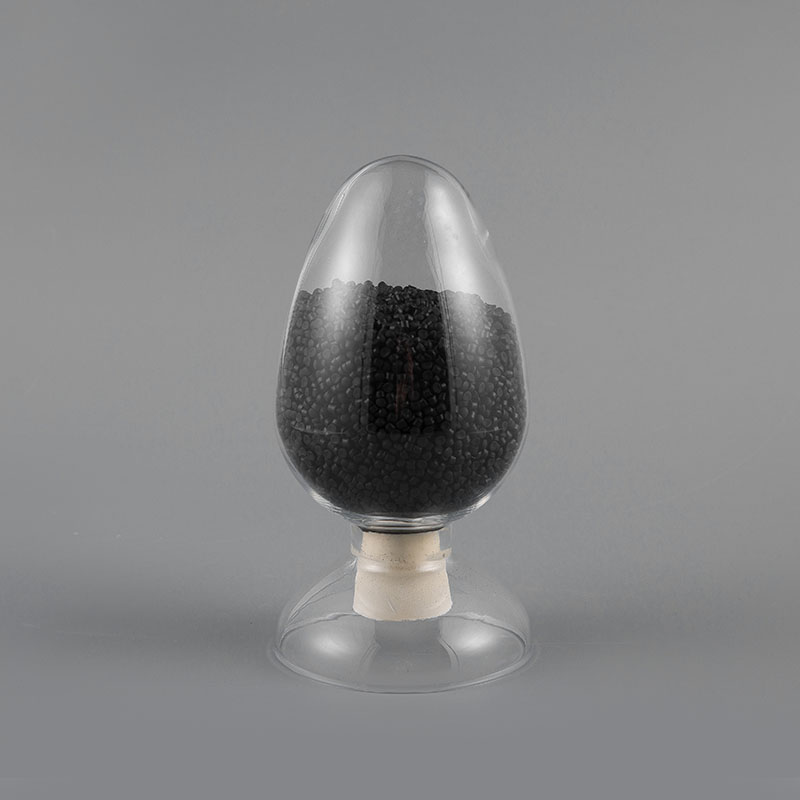
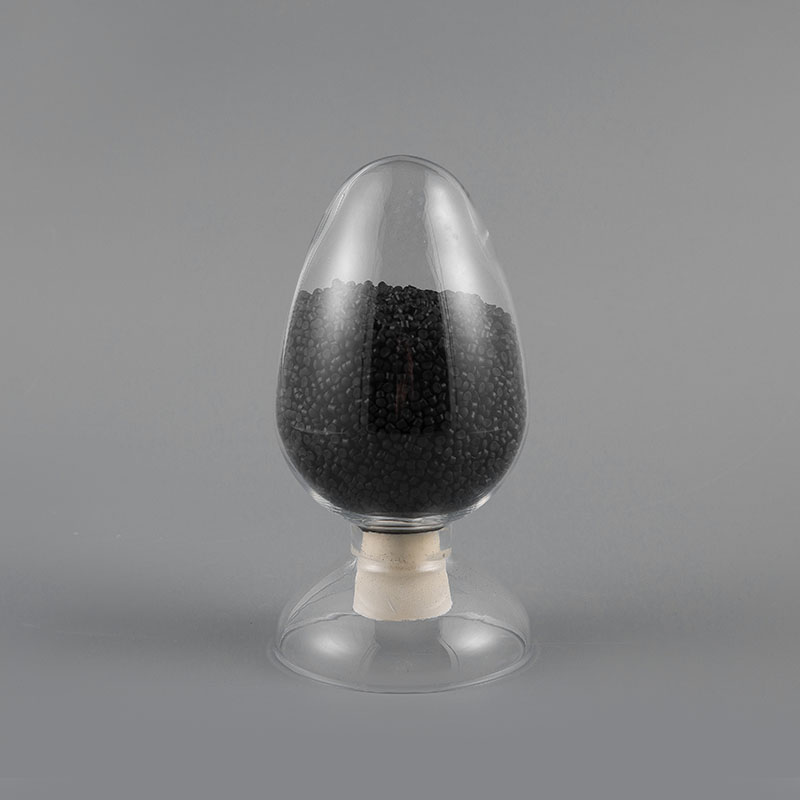 FLRY-B 105°C Thin-Wall Automotive Low-Voltage Wire CompoundFlexible PVC compound for 105°C thin-wall automotive harnesses; view its oil, gasoline and abrasion resistance and 145–185°C extrusion range when routing demands heat and flexibility.View Product →
Comparing PVC, Cross-Linked Polyolefin and Silicone
No single compound family wins on heat, oil and flexibility at once, so the choice follows whichever property the routing cannot compromise.
| Compound family | Service temperature | Oil and fuel behaviour | Flexibility and abrasion | Typical fit |
| Plasticised PVC | 70 °C to 105 °C | Moderate; swells in aromatic fuel, plasticiser extracted by hot oil | High initial flexibility, moderate abrasion | Cab harnesses, 105 °C low-voltage circuits |
| Cross-linked polyolefin | 125 °C to 150 °C | Good retention in hot oil when formulated for it | Good abrasion, lower elongation than PVC | Engine bay, high-voltage EV, thin wall |
| Silicone | 180 °C to 200 °C | Poor in hydrocarbon oil; swells | Very flexible, low abrasion resistance | High-temperature static runs away from oil |
ML-FJ125QB 125°C Halogen-Free Thin-Wall Cable CompoundHigh-temperature halogen-free thin-wall compound for automotive cable insulation; check its -25°C to 150°C range and ISO 6722/SAE J1128 compliance against routing needs.View Product →How to Evaluate a Supplier in Six Steps
Ask for test reports that state conditions and before-and-after values, then check those values against the drawing tolerance, because a pass stamp without data cannot be audited and cannot be compared with a second source.
- Fix the duty cycle first: maximum continuous conductor temperature, fluids present, flex cycles per shift and the wall thickness on the drawing.
- Identify the governing standard and class, then write that class into the purchase specification so a substitution triggers requalification.
- Request ageing and immersion reports that list temperature, hours, fluid type, specimen geometry and measured retention values.
- Ask for three consecutive production lots of hardness, density, tensile strength and elongation data to see how wide the process window really is.
- Verify the test capability behind the report: equipment, calibration dates, and whether testing is in-house or subcontracted.
- Run a pilot extrusion at production line speed before release, checking surface finish, concentricity and drawdown.
Two compounds both carry a 125 °C rating and look interchangeable on paper. One retains 68% of its elongation after 3,000 hours at 125 °C; the other retains 44%. Both pass a voltage withstand test. Only the first survives a mandrel bend at -40 °C after ageing in a 0.35 mm wall. This is a hypothetical scenario built to show how retention data separates two materials that a pass-fail report would present as identical.
In-house laboratory capability is worth confirming directly, because a supplier that measures its own ageing and immersion data shortens the qualification loop: see the laboratory testing equipment used for these checks.
Decisions That Fix the Specification
Which temperature class does an engine-bay harness need?
Class C at 125 °C covers most engine-bay routing; Class D at 150 °C applies near turbochargers, exhaust-adjacent runs and some high-voltage battery interfaces. Measure conductor temperature under load inside the actual bundle instead of assuming it equals ambient air temperature.
Is a higher temperature class always the better choice?
No. Raising the class usually raises hardness and reduces elongation, so a 150 °C cross-linked compound can be less forgiving in a 0.2 mm wall than a 105 °C PVC. Choose the lowest class that covers the measured duty point with margin, then verify flexibility on finished wire.
How long should an oil immersion test run?
Match it to exposure: 24 hours screens gross incompatibility, 168 hours covers splash and seepage zones, and 1,000 hours or more suits wire routed in oil-wetted areas such as transmission and sump harnesses. Record the immersion temperature alongside the hours.
Which document reveals the most about a compound?
A test report that carries before-and-after values with the full condition set, paired with the cable drawing that defines class and wall thickness. Those two documents answer questions a pass-fail certificate never can.