
 English
 中文简体
 русский



Article Directory
- 1 Specify the fire class first, the polymer second
- 2 What a 50 to 65 percent mineral load does to the compound
- 3 Thermoplastic or crosslinked: decide by consequence
- 4 Application map: which standard decides the grade
- 5 Where selection failures show up
- 6 Procurement checklist before you qualify a supplier
- 7 Selection questions that decide the order
A 90 °C halogen-free sheathing compound can pass the single-wire EN 60332-1-2 flame test and still fail the Cca classification written into the purchase order. EN 50399 measures heat release on a tray of bundled cable at 20.5 kW and then at 30 kW, so the fire class belongs to the finished cable design, not to the pellet described on the datasheet.
Specify the fire class first, the polymer second
The working order for a flame retardant polyolefin compound is fire class, continuous operating temperature, crosslinking route, extrusion window, then documentation. Reversing that order is the reason cables get reformulated after a failed type test.
Under EN 50575, cables permanently installed in buildings are classified to EN 13501-6 in seven reaction-to-fire classes: Aca, B1ca, B2ca, Cca, Dca, Eca and Fca. Everything above Eca combines EN 60332-1-2 single-wire testing, EN 50399 bundle testing at 20.5 kW and 30 kW, EN 61034-2 smoke density and EN 60754-2 acid gas conductivity. The practical consequence for compound selection is set out in how flame retardant ratings drive LSZH compound selection: a higher class moves the constraint away from the base polymer and onto the filler system, the char former and the dripping behaviour of the sheath.
A flame retardant polyolefin compound is a polyolefin matrix (EVA, LLDPE, EEA or a blend) loaded with roughly 50 to 65 wt% of a mineral hydroxide such as aluminium hydroxide or magnesium hydroxide, together with a compatibiliser, a processing aid and usually a silicone or char-forming synergist. It retards flame through endothermic decomposition and dilution of combustible gases, without halogen chemistry.
- Fix the fire class and the installation standard: B2ca for an EU riser, UL 1685 for a plant tray.
- Fix the continuous operating temperature from the product standard: 70, 90, 105, 125 or 150 °C.
- Choose the crosslinking route: thermoplastic, silane, peroxide or electron-beam irradiation.
- Check the extrusion window on the line you actually own, not on a reference line.
- Collect the paperwork: classification report, type tests, batch certificate of analysis, RoHS and REACH declarations.
What a 50 to 65 percent mineral load does to the compound
At that loading the filler, not the polymer, governs the compound. Published HFFR jacket formulations, including US20210147662A1, describe aluminium hydroxide loadings of 50 to 65 wt%. Below that band flame performance falls away; above it, elongation at break and extrusion output become the constraint.
Aluminium hydroxide decomposes endothermically at roughly 180 to 200 °C and releases water vapour; magnesium hydroxide decomposes near 330 °C. The gap is a processing decision as much as a fire decision: ATH systems run in an extrusion window below about 200 °C, while peroxide crosslinking in a continuous vulcanisation tube is hot enough that MDH-based systems are normally chosen.
Uncoupled mineral filler drops tensile strength and elongation at break. Maleic anhydride grafted polyethylene restores filler-matrix adhesion, and a silicone or char-forming additive raises the residue. Confirm it with EN 60811-501 tensile and elongation tests on the finished insulation or sheath, not on a plaque supplied with the datasheet.
Limiting oxygen index to ISO 4589-2 is a laboratory screening number. It does not predict EN 50399 performance, because heat release on a bundled tray depends on char strength and dripping as much as on oxygen index.
Thermoplastic or crosslinked: decide by consequence
Thermoplastic LSZH fits 70 to 90 °C building and communication cables where conversion cost and scrap recycling matter. Crosslinked LSZH is the correct choice when the cable must hold 105 to 150 °C, pass a hot-set test to EN 60811-507, or tolerate repeated flexing.
Thermoplastic LSZH
- No curing step; standard single-screw extrusion
- Production scrap can be re-pelletised in-house
- Typical ratings of 70 to 90 °C; 105 °C grades need ageing data
- Softens under sustained load close to its rating
- Lower conversion cost per kilometre
Crosslinked LSZH
- Silane, peroxide or electron-beam crosslinking
- Stable from 105 to 150 °C depending on the grade
- Verified by hot-set and gel-content checks
- Scrap cannot simply be re-melted into the same product
- Higher cost, but demanded by rail, PV and industrial specs
| Property | FR-PVC | Thermoplastic LSZH | Crosslinked LSZH (XLPO) |
| Halogen content | Chlorinated base polymer; EN 60754-1 quantifies evolved gas | Halogen-free formulation | Halogen-free formulation |
| Acid gas, EN 60754-2 | Hydrogen chloride release dominates | Near-neutral combustion gases | Near-neutral combustion gases |
| Smoke, EN 61034-2 | Higher; managed with smoke suppressants | Low | Low |
| Flame package | Phosphate plasticiser plus antimony trioxide or zinc borate synergists | 50 to 65 wt% ATH or MDH with compatibiliser | 50 to 65 wt% ATH or MDH plus curing route |
| Typical rating | 70 to 105 °C | 70 to 105 °C | 105 to 150 °C |
| B2ca and Cca coverage | Possible; smoke and acid gas are the limiting factors | Designed for it | Designed for it |
| End of life | Established PVC recycling routes | Re-meltable but filler-rich | Not re-meltable |
| Main watch-out | Smoke and acid gas in confined spaces | Deformation under sustained load | Crosslink density control |
Application map: which standard decides the grade
Four standards cover most flame retardant polyolefin decisions: EN 50575 with EN 13501-6 for EU building cables, UL 1685 or IEC 60332-3-24 for industrial tray installations, EN 45545-2 requirement sets R15 and R16 for rolling stock, and EN 50618 or IEC 62930 for photovoltaic cable.
| Application | Deciding standard | Compound family | Parameter that decides |
| Building wire, EU | EN 50575 with EN 13501-6, EN 50399, EN 61034-2 | Crosslinked or thermoplastic LSZH | Heat release rate in the bundle test |
| Data and communication cable | Cca or Dca to EN 50575; NFPA 262 in plenum markets | LSZH graded to B2ca and Cca | Smoke density inside a vertical shaft |
| Industrial tray and plant | UL 1685; IEC 60332-3-24 category C | Thermoplastic LSZH or XLPO | Damage height after a 20-minute exposure |
| LV and MV power cable | IEC 60502-1; EN 60332-1-2 | XLPE, ZPE and FR-PVC sheaths | Single-wire flame propagation |
| Rail rolling stock | EN 45545-2 sets R15 and R16 | XLPO LSZH | Smoke and toxicity at hazard level HL1 to HL3 |
| Photovoltaic cable | EN 50618; IEC 62930 | Irradiation-crosslinked LSZH | Heat and UV ageing at 1.5 kV DC |
Building wire is the tightest case by volume. A 105 °C irradiation-crosslinked LSZH insulation carrying a B1 classification needs a filler system that keeps elongation after ageing and a char former that holds heat release inside the EN 50399 curve.
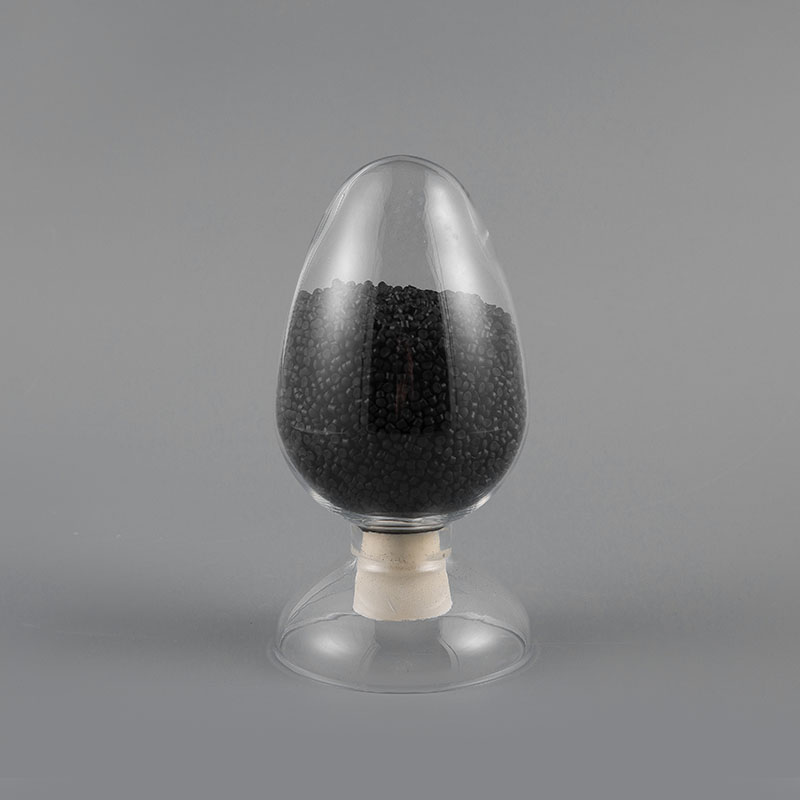 ML-FJ105B1 105°C Cross-Linked LSZH B1 Insulation105°C cross-linked LSZH B1 insulation for building wire, intended to support ageing elongation and heat-release performance in tightly specified wire constructions.View Product →
Power cable sheathing pulls in the opposite direction: a 90 °C thermoplastic LSZH sheath classified B1 has to stay flexible on a three-core armoured construction, which is exactly where filler loading and low-temperature performance conflict.
ML-H9001B1 Thermoplastic LSZH B1 Sheath for Power and Control CablesThermoplastic LSZH B1 sheath for power and control cables, designed for bundled combustion performance and 60% light transmittance in cable constructions.View Product →
Data cable adds smoke to the equation, because a B2ca sheath must limit both heat release and optical density while still stripping cleanly at the connector end.
ML-TH9001B2ca 90°C Low-Smoke Communication Cable Sheath Compound90°C halogen-free low-smoke flame-retardant sheath compound for communication cables, including data, coaxial/network and fiber-optic cables, with extrusion-ready formulation.View Product →Where selection failures show up
Most flame retardant polyolefin failures on the line are process failures, not chemistry failures. Moisture pickup, poor filler dispersion and wrong crosslink density account for more rejections than the choice of base polymer.
- Moisture: hydroxide-filled compounds absorb water, so drying is mandatory and the supplier's drying curve, not a default setting, defines temperature and residence time.
- Dispersion: a rising screen pack pressure and a falling elongation at break are the first signals; agglomerates also make flame results drift between lots.
- Crosslinking: hot-set to EN 60811-507 and gel content confirm curing density, with under-cured silane compound failing deformation and over-cured compound turning brittle.
- Ageing: EN 60811-401 oven ageing at the temperature class declared on the certificate shows whether the filler package was stabilised for that rating.
Hangzhou Meilin New Materials Technology Co., Ltd. compounds flame retardant polyolefins and PVC from three plants in Lin'an, Hangzhou, on 31 automated lines, and publishes its in-house laboratory testing equipment as part of the supplier record. That list is one of the first things to request from any candidate, because dispersion and ageing claims are only as good as the instruments behind them.
A compound approved on a datasheet is a hypothesis. Approve it on three finished-cable results: a bundle flame test, a smoke density test, and elongation after oven ageing at the declared temperature class.
Procurement checklist before you qualify a supplier
Qualify a flame retardant polyolefin supplier on eight documents, not on price per kilogram.
- EN 13501-6 classification report for a cable built with the compound.
- Type test reports to EN 60332-3-24 or UL 1685, depending on the destination market.
- EN 60754-1 and EN 60754-2 halogen and acid gas data.
- EN 61034-2 smoke density results at the wall thickness you actually run.
- Batch certificate of analysis covering density, melt flow rate, tensile strength and elongation to EN 60811-501.
- Hot-set and gel-content data to EN 60811-507 for crosslinked grades.
- RoHS and REACH SVHC declarations, plus a lead-free statement where the market requires one.
- A UL yellow card file number where UL-listed cable is the end product.
Then run a line trial: two extrusion runs on the same screw, one at the recommended profile and one 10 °C cooler, measuring surface finish, screen pack pressure rise and elongation on both. A compound that works in only one narrow window is a production risk whatever its classification.
Selection questions that decide the order
Does a higher limiting oxygen index mean a better cable?
No. ISO 4589-2 measures oxygen index on a small specimen, while EN 50399 classification depends on heat release from a bundled tray, where char strength and dripping dominate. A compound with a high oxygen index can still fail B2ca if it releases flaming particles.
Can a B2ca-rated compound be used at 105 °C?
Only if the grade carries the thermal data. Fire class and temperature class are independent properties: a B2ca sheath may be rated 90 °C, and running it at 105 °C requires EN 60811-401 ageing and deformation results at that temperature from the compound supplier.
How much aluminium hydroxide does a flame retardant polyolefin need?
Published HFFR formulations for wire and cable use 50 to 65 wt% aluminium hydroxide, as described in US20210147662A1. Below that range flame performance falls quickly; above it, elongation at break and extrusion output become the limit, which is why compatibilisers and char formers are used instead of simply adding more filler.
Which single test catches the most supplier problems?
Elongation at break after oven ageing, run to EN 60811-501 and EN 60811-401 at the temperature class declared on the certificate. It exposes under-stabilised filler packages, poor dispersion and moisture-damaged lots earlier than a flame test does, at a fraction of the cost of a bundle test.