
 English
 中文简体
 русский



Article Directory
- 1 What a High Voltage Cable Compound Has to Deliver
- 2 Voltage Class Decides the Compound Grade
- 3 The XLPE Baseline and Where Silane Crosslinking Stops
- 4 Contamination, Moisture and Degassing: What the Datasheet Omits
- 5 Semiconductive Screens Are Half the Insulation System
- 6 Incoming Inspection Before Extrusion
- 7 Sheath and Flame Performance on Industrial Routes
- 8 Practical Questions from Cable Manufacturers
When a 132 kV cable fails its routine partial-discharge screen at 5 pC, the extrusion line is examined first and the compound is examined last. The order is usually reversed. Partial discharge, hot-set and breakdown failures on high voltage cable trace back to three properties a compound certificate does not show: cleanliness, moisture and the completeness of crosslinking. For an industrial power cable manufacturer, all three are decided in the purchase specification, months before the first metre is extruded.
What a High Voltage Cable Compound Has to Deliver
An insulation compound for high voltage cable must meet four requirements at the same time: low dielectric loss, dielectric strength that survives the standard AC and impulse tests, thermal and mechanical endurance at the design conductor temperature, and processing behaviour that adds no defects during extrusion. A grade that misses any one of them fails at cable test stage, not at compound stage.
- Dielectric loss: dissipation factor must stay low and stable across the service temperature range, because loss governs insulation thickness and current rating at the upper end of the voltage range.
- Dielectric strength: the cured insulation has to hold the AC voltage test and lightning impulse levels of the cable standard, and support the routine partial-discharge limit, for example 10 pC under IEC 60502-2.
- Thermal and mechanical endurance: 90 C continuous conductor temperature and 250 C during a short circuit, with deformation checked by the hot-set test in IEC 60811-507.
- Processability: the compound must run on the qualified line at the qualified melt temperature and output, and stay free of contamination through conveying, drying and storage.
A high voltage cable compound is a formulation qualified for the insulation or semiconductive layer of a cable rated above 30 kV (Um 36 kV), where cleanliness, moisture content, crosslinking behaviour and degassing are specified with the same weight as electrical properties.
Voltage Class Decides the Compound Grade
Cable standards split the market into three insulation regimes: IEC 60502-2 covers 1 kV to 30 kV, IEC 60840 covers above 30 kV to 150 kV, and IEC 62067 covers above 150 kV to 500 kV. The compound qualification level changes at every boundary, and so does the evidence a supplier must provide.
Below 36 kV, the insulation wall is comparatively thin and the electric stress is moderate, so silane crosslinked XLPE remains a practical choice. Above 36 kV, wall thickness and stress at the screen interface rise, and only superclean peroxide grades with controlled byproduct levels fit the design.
| Rated voltage range | Cable standard | Insulation compound expectation |
| 1 kV to 30 kV (Um 1.2 to 36 kV) | IEC 60502-2 | Peroxide or silane XLPE; thermoplastic PVC and LSZH at the low end |
| Above 30 kV to 150 kV (Um 36 to 170 kV) | IEC 60840 | Superclean peroxide XLPE with bonded semiconductive screens, degassed after cure |
| Above 150 kV to 500 kV (Um 170 to 550 kV) | IEC 62067 | Superclean low-loss peroxide XLPE, tighter partial-discharge and moisture limits |
The XLPE Baseline and Where Silane Crosslinking Stops
Peroxide crosslinked XLPE is the default insulation above 30 kV. Silane crosslinked XLPE serves 35 kV and below, where a water bath cure is sufficient and equipment cost weighs more than dielectric margin.
The difference is chemistry, not marketing. Dicumyl peroxide decomposes during cure into acetophenone, cumyl alcohol, methane and alpha-methylstyrene. Those residues raise dissipation factor and must be removed by degassing before the tan delta limits at the top of the voltage class can be reached. The reliability of that route depends on cure conditions as much as on formulation, which is covered in this note on what makes peroxide XLPE compounds reliable for power cables.
- Voltage range: 30 kV to 500 kV
- Cure: pressurised continuous vulcanisation line
- Residue: acetophenone, cumyl alcohol, methane
- Constraint: degassing time scales with wall thickness
- Voltage range: up to 35 kV
- Cure: water bath or ambient moisture
- Residue: lower boiling point byproducts
- Constraint: moisture access limits wall thickness
Insulation portfolios aimed at industrial and distribution projects typically stop at the 35 kV ceiling, so the grade list a manufacturer buys from is narrower than the standard range suggests. A representative example is this peroxide XLPE grade for cable insulation up to 35 kV, where crosslinking behaviour and hot-set values are the buying criteria rather than headline dielectric figures.
 ML-YJ35 Peroxide XLPE Insulation Compound for 35 kV CablesPeroxide XLPE insulation compound for power cables up to 35 kV, listed to JB/T 10437-2004; a representative grade when crosslinking and hot-set values guide specification.View Product →
Contamination, Moisture and Degassing: What the Datasheet Omits
Three defect sources decide whether a compliant compound becomes a compliant cable: retained contamination, absorbed moisture and incomplete degassing. None of them appears on a typical datasheet, so all three have to be written into the purchase specification.
- Contamination: particles above the agreed size create stress concentrations that start trees and partial discharge. High voltage grades are specified by maximum particle size and checked by pellet or tape inspection, not by an average count.
- Moisture: absorbed water forms voids during extrusion and feeds water treeing in service. Set a Karl Fischer moisture limit in the specification and require moisture-barrier packaging, because a foil bag opened on a humid floor returns to equilibrium quickly.
- Degassing: residual peroxide byproducts must be removed after cure, and the acceptable level depends on voltage class and insulation thickness. It is verified on finished cable, never on pellets.
A compound can pass every electrical property on its certificate and still fail a 5 pC routine test if pellets are stored in humid air or conveyed through an open system. Handling is part of the specification, not part of the operator's discretion.
Semiconductive Screens Are Half the Insulation System
The conductor screen and the insulation screen control electric stress at both insulation interfaces. Above 30 kV, screen smoothness, bonding and strippability influence impulse and partial-discharge performance as much as the insulation compound itself.
Screen compounds are carbon black loaded crosslinkable formulations. What matters in purchasing is not the black content but the finished surface: protrusions at the insulation interface act as stress points, volume resistivity must stay low enough to equalise the field along the conductor, and the insulation screen must be strippable at the joint without tearing the insulation beneath it. Triple-layer simultaneous extrusion is standard practice for a reason, because a smooth interface cannot be created afterwards.
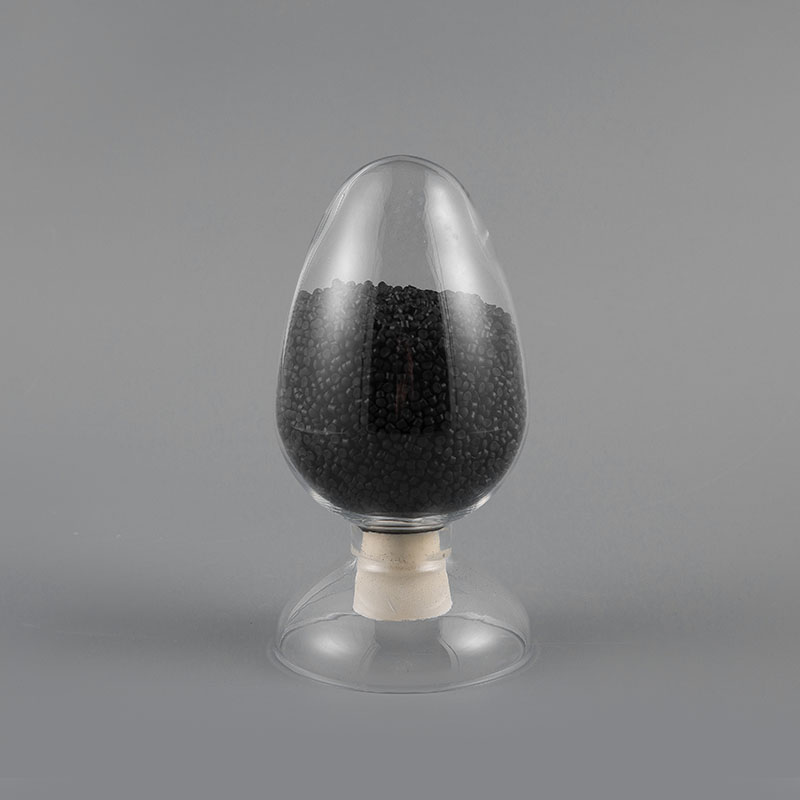 ML-PSD Semi-Conductive Conductor Screen for 10 kV XLPE CablesSemi-conductive crosslinkable conductor screen for XLPE power cables up to 10 kV, listed to JB/T 10738; relevant when specifying screen compounds and incoming checks.View Product →
Incoming Inspection Before Extrusion
Four incoming checks cover most of the risk in a high voltage compound: hot-set, moisture, contamination and pellet consistency. Each has a defined method that can be written into a purchase order and repeated at goods receipt.
| Check | Method | Typical specification target |
| Hot-set elongation under load | IEC 60811-507, 200 C, 0.2 MPa, 15 minutes | Up to 175% on a cured sample |
| Permanent deformation | IEC 60811-507 | Up to 15% after cooling |
| Moisture content | Karl Fischer titration | Agreed limit, HV grades in the low hundreds of ppm |
| Contamination | Optical inspection of pellets or pressed tape | No particle above the size agreed for the grade |
| Density | ISO 1183 | 0.92 g/cm3 nominal for XLPE grades |
Beyond the test data, ask for the report pack and the calibration status of the instruments behind it. A supplier that publishes its laboratory testing equipment and production environment is easier to audit than one that sends a certificate with no traceable method.
Sheath and Flame Performance on Industrial Routes
The oversheath carries no dielectric duty but decides whether the cable survives water ingress, abrasion, rodents and fire exposure. Sheath compounds are selected against the installation standard and the fire class of the finished cable, not against the insulation grade.
On industrial sites, three sheath families dominate. Flame-retardant polyethylene is used on high voltage routes where moisture resistance and low water vapour transmission matter more than flexibility. PVC grades at 70 C and 90 C remain common where cost and mechanical toughness drive the decision. Halogen-free sheaths appear where smoke density and corrosivity are controlled on the cable, not on the compound. In each case, the compound quantity to specify is the one on the drawing: sheath thickness, adhesion to the screen and the fire test class of the finished cable.
ML-ZRPE-H Flame-Retardant Polyethylene Sheath for High-Voltage CablesHalogen-free, low-smoke flame-retardant PE sheath compound for high-voltage cables, stated to GB/T 11017 ST12 and bundle combustion A/B; relevant when sheath fire performance is specified.View Product →Practical Questions from Cable Manufacturers
Which compound fits a 33 kV industrial feeder?
A 33 kV feeder sits inside IEC 60502-2, which runs to 30 kV rated and Um 36 kV. Both peroxide and silane crosslinked XLPE are used at this level: peroxide where partial-discharge margin is tight, silane where curing equipment is water based. Specify hot-set, moisture and screen properties as one package, because the insulation grade alone does not determine the test result.
How is degassing verified rather than assumed?
No single numeric limit applies across voltage classes. Degassing is verified on finished cable through dissipation factor measurement at power frequency and at elevated temperature, plus residual byproduct or gas evolution tests agreed with the customer. Wall thickness and cure temperature set the required degassing time, so the schedule belongs in the process specification.
Do B2ca or Cca ratings apply to the insulation compound?
No. EN 13501-6 classes such as B2ca and Cca are assigned to the finished cable from fire test results, and they are driven mainly by the sheath and the overall construction. The insulation contributes through halogen content, smoke and acidity, but the class is a cable property, not a compound property.
What belongs in a purchase specification beyond dielectric strength?
At minimum: moisture limit with test method, contamination limit and inspection method, hot-set values per IEC 60811-507, semiconductive screen volume resistivity and surface smoothness, packaging and storage conditions, and the test report pack per delivery. These are the items that decide whether the compound survives routine partial-discharge testing at 10 pC.