
 English
 中文简体
 русский



Article Directory
- 1 Three Compound Families, Three Sets of Requirements
- 2 Insulation Compound Requirements: Cleanliness, Crosslinking and Hot Set
- 3 Semiconductive Screens: The Interface That Decides Cable Life
- 4 Sheath Compound Requirements: Moisture Barrier First, Flame Barrier Second
- 5 Incoming Inspection on Every Compound Lot
- 6 Specification Questions That Decide Approval
At 145 kV, a typical XLPE cable carries about 19 mm of crosslinked polyethylene over its conductor screen, and one contaminant particle that survives extrusion can start the electrical tree that ends that cable's service life decades early. That is why high voltage cable compounds are bought as fully formulated, pre-tested systems with a documented cleanliness class, not as base resin plus additives blended at the cable plant.
Three Compound Families, Three Sets of Requirements
A high voltage cable uses three compound families — semiconductive screens, crosslinked insulation and an oversheath — and each is released against different clauses of IEC 60840 for 30 kV to 150 kV or IEC 62067 for 150 kV to 500 kV.
The split matters commercially. A supplier that offers a qualified insulation grade but treats the semiconductive screen as an accessory creates the most common failure pattern in high voltage cable building: an insulation wall with excellent hot-set data and an interface that fails in the type test. Qualify all three families against the same voltage class and the same cleanliness regime.
A high voltage cable compound is a fully formulated, pelletised polymer system in which polymer, filler, stabiliser, crosslinking agent and process aid are already combined by the compounder, so that dielectric performance and cleanliness are the supplier's responsibility rather than an outcome of on-site mixing.
| Layer | Typical compound | Primary requirement | Verification basis |
| Conductor screen | Crosslinkable semiconductive compound | Volume resistivity at or below 100 ohm-centimetre at 90 °C; smooth, void-free interface | Supplier datasheet, then cable type test |
| Insulation | Peroxide-crosslinked XLPE | Hot-set elongation 175 % maximum and permanent deformation 15 % maximum at 200 °C | IEC 60840 and IEC 60502-2 hot-set test |
| Insulation screen | Strippable or bonded semiconductive compound | Peel force inside an agreed window; protrusions limited to a few tens of microns | Buyer specification plus jointing trial |
| Oversheath | PE to ST2, PVC to ST1 or halogen-free ST7 | Tensile strength 12.5 MPa minimum; PE elongation at break 300 % minimum | IEC 60502-2 sheath tests |
Metallic screens, bedding tapes and armour sit outside this table because they are bought to dimensional and conductivity specifications rather than to a dielectric formulation.
Insulation Compound Requirements: Cleanliness, Crosslinking and Hot Set
Insulation compound for cables rated above 30 kV must pass the hot-set test at 200 °C — 15 minutes under 0.2 MPa — with elongation at or below 175 % and permanent deformation at or below 15 %, and it must be clean enough that no contaminant above the agreed limit reaches the extrusion head.
Crosslinking method sets the voltage ceiling
Peroxide crosslinking dominates above 66 kV because the reaction is triggered by heat inside a pressurised continuous vulcanisation line and does not depend on moisture diffusing through a thick wall. Silane crosslinking cures by water uptake and is normally limited to 35 kV and below, where wall thickness stays modest.
Peroxide XLPE
- Applied from 66 kV to 500 kV, and the default above 110 kV
- Dicumyl peroxide decomposed at roughly 180 °C to 200 °C in a dry-cure tower
- Leaves acetophenone, cumyl alcohol and alpha-methylstyrene that must be degassed
- Requires triple extrusion with dry curing and dry cooling
Silane XLPE
- Applied at 35 kV and below, including aerial insulated cable
- Crosslinked by moisture diffusion after extrusion
- Volatile residues are mainly methanol and silane by-products
- Runs on conventional extrusion lines with a water bath or sauna cure
 ML-YJ35 Peroxide XLPE Insulation Compound for Up to 35 kV CablesPeroxide XLPE insulation compound for power cables up to 35 kV, compliant with JB/T 10437-2004, offering a specified material option for this cable-insulation application.View Product →
Degassing is a compound decision, not only a process decision
Crosslinking by-products raise dielectric loss and can nucleate voids if they stay in the wall. Cables are therefore held in ovens, typically between 60 °C and 80 °C, for periods measured in days and, at 220 kV and above, in weeks. A low-by-product formulation shortens that holding time and reduces the risk of a batch that never quite reaches the dissipation-factor target.
Electrical acceptance limits that separate HV from MV grades
Volume resistivity is usually specified at 1 x 10^14 ohm-metre or higher at 20 °C, and dissipation factor at or below 1 x 10^-3 at 50 Hz, with 220 kV and 400 kV designs pushed toward 5 x 10^-4. Those limits only hold if the compound arrives clean, so cleanliness class, packaging and handling belong in the purchase specification alongside the electrical data.
Semiconductive Screens: The Interface That Decides Cable Life
Semiconductive compounds must hold volume resistivity at or below 100 ohm-centimetre at 90 °C and present a smooth, firmly bonded surface, because the screen-to-insulation interface carries the highest electrical stress anywhere in the cable.
Stress at the screen interface scales with the inverse of the protrusion radius. A 50-micron bump concentrates roughly twice the field of a 100-micron bump at the same voltage, which is why screen smoothness is specified separately from screen conductivity.
The conductor screen equalises the field over the stranded conductor; the insulation screen does the same at the outer boundary and, when strippable, must also release cleanly during jointing without tearing the insulation. Peel force is therefore written as a window rather than a minimum: too high and crews damage the wall, too low and the screen lifts in service.
Protrusion limits tighten with voltage class. Specifications for 220 kV and above often cap protrusions at the insulation screen to 50 microns or less, and supersmooth grades are qualified by extruded-tape surface measurement rather than by a bulk property. The semiconductive compound selection guide sets out how bonded and strippable screens differ in acceptance testing.
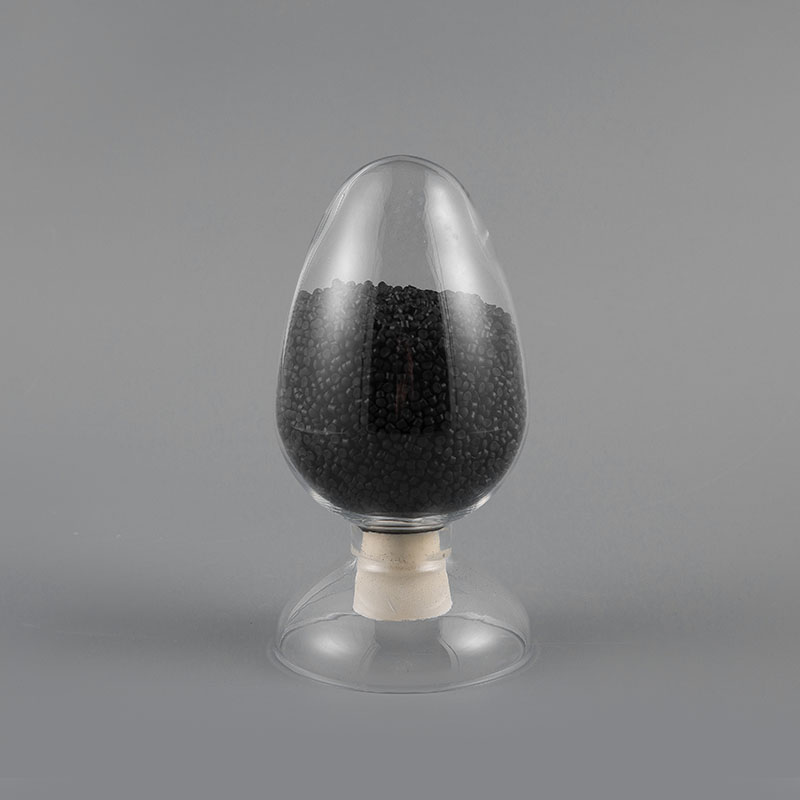 ML-PSD Semi-Conductive Conductor Screen for XLPE Cables Up to 10 kVA crosslinkable semi-conductive conductor screen for XLPE cables up to 10 kV, meeting JB/T 10738 and relevant to screen selection in cable construction.View Product →
Sheath Compound Requirements: Moisture Barrier First, Flame Barrier Second
A high voltage oversheath is specified first as a moisture and mechanical barrier and only second as a flame barrier, which is why PE to ST2 is the default choice and PVC to ST1 or halogen-free ST7 appear where fire performance or site rules dominate.
PE sheath compound is bought to a narrow mechanical band: tensile strength of at least 12.5 MPa and elongation at break of at least 300 % under IEC 60502-2, with carbon black content between 2.0 % and 2.5 % by mass where the cable is exposed to sunlight. PVC to ST1 holds the same 12.5 MPa tensile but only 125 % elongation, and it trades moisture resistance for flame retardancy and easier handling at low temperature.
On cables that will be DC-tested after installation, a bonded semiconductive layer is extruded over the PE sheath so that the test voltage has a defined return path. That layer is a separate compound with its own resistivity limit, not a thin version of the insulation screen.
The sheath is the last line of defence against water treeing and corrosion. A sheath that passes tensile and elongation but absorbs moisture through poor carbon black dispersion will still fail the completed cable, so compounders test moisture absorption and surface finish, not just mechanical data.
Where flame retardancy is required without giving up the PE base, flame-retardant polyethylene sheath compounds keep the moisture barrier behaviour while meeting the flame spread requirements of the project. They are the practical middle option between plain ST2 and a halogen-free ST7 sheath.
ML-ZRPE-H Halogen-Free Low-Smoke Flame-Retardant Sheath Compound for HV CablesA halogen-free, low-smoke ZPE sheath compound for high-voltage cables, meeting GB/T 11017 ST12 and passing bundle combustion A/B tests; a PE-based flame-retardant option.View Product →Incoming Inspection on Every Compound Lot
Every high voltage compound lot should clear six checks before it reaches the hopper, and the first four are documentary rather than physical.
- Certificate of analysis values matching the purchased grade on hot set, tensile strength, elongation, volume resistivity and dissipation factor
- Gel content confirmation, normally at 80 % or above by solvent extraction
- A stated cleanliness class and contamination limit, with the sampling method named
- Packaging integrity: foil-lined or moisture-barrier bags, intact seals and an in-date shelf life
- Plaque or tape test on the received lot to confirm the certificate values
- Short extrusion trial on the actual line before a full production run
Suppliers who publish their laboratory testing equipment make this verification easier, because the buyer can match the supplier's test methods to the incoming inspection plan instead of comparing unlike numbers.
Specification Questions That Decide Approval
Why can a medium voltage XLPE compound not simply be used above 30 kV?
Because the acceptance criteria change, not just the price. A 30 kV grade is qualified on hot-set data and routine tests, while IEC 60840 adds a full type-test sequence including heating cycle and impulse tests on a completed cable with walls around 19 mm, and IEC 62067 adds a further step for 150 kV to 500 kV. Contamination limits, protrusion limits and by-product content all tighten with each step.
Does a thicker sheath allow a thinner insulation wall?
No. Insulation wall thickness is set by the design stress at the conductor screen and by lightning impulse withstand, not by the oversheath. For a 145 kV cable the insulation wall is typically 19 mm to 20 mm, and for 400 kV designs it approaches 30 mm regardless of whether the sheath is 3 mm or 4 mm.
What temperature class applies to XLPE insulation compound?
Crosslinked polyethylene is rated for a continuous conductor temperature of 90 °C, an emergency rating of 105 °C to 130 °C depending on the standard invoked, and a short-circuit rating of 250 °C for up to 5 seconds. Those figures come from IEC 60502-2 and IEC 60840 and apply to the finished cable, not to the compound alone.
When is a halogen-free sheath required instead of PE?
Where cable runs through tunnels, indoor substations, stations or confined spaces covered by fire-safety rules, halogen-free ST7 replaces ST2. The trade-off is real: ST7 compounds are more moisture sensitive and usually show lower elongation than PE, so the jointing and handling procedure has to be adjusted rather than reused unchanged.